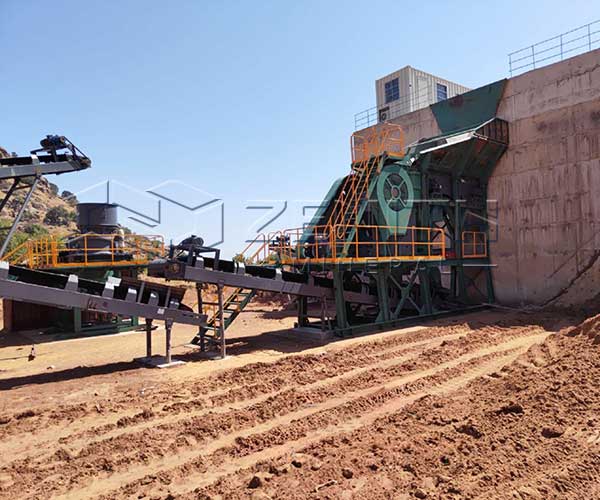
Ethiopia’s construction surge, driven by megaprojects like the Grand Ethiopian Renaissance Dam, hinges on a robust cement industry. At its core lies limestone, the primary raw material comprising about 80% of cement’s composition.
The journey from rugged quarry faces to fine cement powder exemplifies industrial ingenuity amid Ethiopia’s economic transformation.
Quarrying kicks off the limestone odyssey in Ethiopia’s semi-arid landscapes. Open-pit methods dominate at sites like the National Cement Factory’s multi-bench quarry.
Operators use hydraulic excavators and bulldozers for initial clearing, storing topsoil for later rehabilitation to combat erosion. Drilling follows with pneumatic rigs boring 10-15 meter deep holes in a grid pattern, spaced 3-4 meters apart to optimize blast fragmentation.
Oversized boulders undergo secondary breaking with hydraulic hammers. This stage yields raw limestone ready for transport, with daily outputs reaching 5,000 tons at peak operations.
From the quarry face, haul trucks—typically 40-ton capacity—ferry limestone to on-site primary crushers, often just 1-2 km away to cut costs. At this stage reduces boulders from 1 meter to 200-300 mm, priming them for finer processing.
Jaw crushers reign supreme here, their fixed and movable jaws exerting 100-200 tons of force per stroke. Ethiopian adaptations include dust hoods and water sprays, addressing the high silica content in local stone that amplifies abrasion.
Vibrating feeders regulate input, preventing jams, while belt conveyors whisk output to stockpiles.
This phase consumes significant energy—about 5-10 kWh per ton—but variable speed drives in modern units like ZENITH’s optimize efficiency.
Secondary crushing elevates efficiency, targeting 20-50 mm output via cone or impact crushers. Cone crushers, with their eccentric shafts and mantle, deliver high reduction ratios (4:1 to 6:1), ideal for Ethiopia’s variable limestone hardness (Mohs 3-4).
Impact crushers shine for softer ores, using rotor velocity to shatter via collision, though they generate more fines—beneficial for cement’s raw meal.
Tertiary stages employ vertical shaft impactors (VSI) for cubical shapes under 10 mm, enhancing downstream grinding. Closed-circuit setups with vibrating screens recycle oversize, achieving 90% passing the target size.
Belt conveyors, spanning kilometers, link stages, with magnetic separators removing tramp iron from blasts.
Dust collection systems—comply with air quality norms.
Post-crushing, multi-deck vibrating screens stratify limestone into fractions: 0-5 mm for cement, 5-20 mm for aggregates, and coarser for roads. High-frequency models ensure sharp separations, critical for uniform raw mix chemistry.
In Ethiopia’s heat, water-cooled screens prevent clogging. Automated samplers test for CaO content (52-56%), rejecting subpar lots to maintain clinker quality.
Stockpiles, covered to shield from rain, hold 50,000 tons, rotated via stackers and reclaimers for homogeneity. Rail or truck links to plants, 100 km away, use covered hoppers.
Four-deck screens yield precise bands: <5 mm (40%), 5-10 mm (25%), etc.
Stockpile management averts segregation, ensuring consistent kiln feed.
This interlude buffers fluctuations, stabilizing Ethiopia’s cement output amid power grid variability.
Crushed limestone joins clay and iron ore in raw mills—ball or vertical roller types—for pulverization to 80-90 microns. Vertical rollers, grind and dry simultaneously via hot gases, slashing energy to 30 kWh/ton.
Pre-blending beds homogenize feeds, with weigh feeders dosing ratios: 85% limestone, 10% clay, 5% additives. Cyclone separators refine the meal, looping coarse particles.
Ethiopian mills incorporate local pozzolana for blended cements, cutting clinker needs by 20% for sustainability.
Ball mills’ cascading media achieve finer grinds but at higher power (40 kWh/ton).
Blending silos use compressed air for uniformity, targeting <1% variance.
The raw meal enters the preheater tower, climbing through cyclones to 900°C, then the rotary kiln at 1450°C. Here, limestone decomposes (calcination), forming clinker’s calcium silicates.
Ethiopia’s dry-process kilns, like Derba’s 5,000 tpd, use petcoke fuel, with preheaters recovering 70% heat. Coolers arrest clinker at 100°C, recycling air.
Emissions—CO2 from decarbonation—prompt trials with biomass co-firing.
Clinker, ground with 5% gypsum in finish mills, yields OPC or PPC cement at 3,200 cm²/g fineness. Vertical mills dominate for efficiency.
We have jaw crushers, impact crushers, cone crushers, sand makers and so on.
Mon - Sun, 0:00 - 24:00
24h Online Service
© Zenith. All Rights Reserved. Designed by


 WhatsAPP 24h online service


 24h Online Chat


