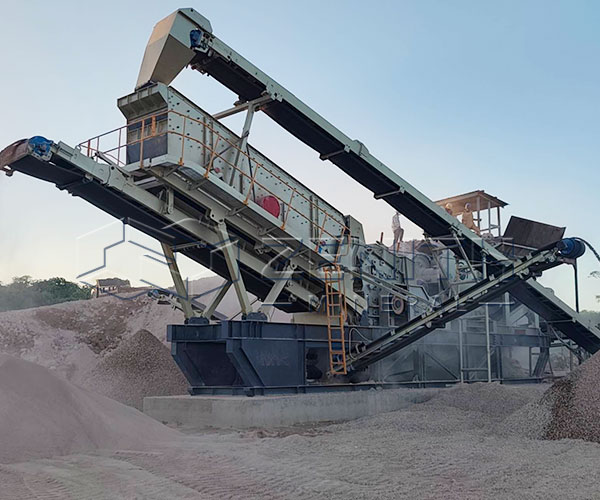
Ethiopia has seen rising investment in infrastructure, road construction, and mining, which has amplified demand for stone crushing and mineral processing equipment. Local basalt deposits—often weathered and moderately abrasive—shape equipment choices, with many operators favoring jaw + impact configurations over jaw + cone for secondary stages.
The country’s typical basalt crushing lines target 150–300 tph, producing 0–5 mm, 5–10 mm, and 10–20 mm aggregates for road and building projects.
Shipment costs from Asia can add 15–20% to equipment prices due to long sea routes and complex inland logistics.
Primary crushing in Ethiopia is dominated by jaw crushers, with gyratory crushers used in large-scale mining requiring very high throughput. Jaw crushers are valued for reliability, simplicity, and ability to handle large feed sizes in surface mining and quarrying.
Secondary crushing refines the product size and shape, while tertiary crushing targets fine aggregates and sand. In Ethiopia, the choice between cone and impact crushers is strongly influenced by basalt characteristics: weathered basalt often favors impact crushers, while fresher, harder basalt may justify cone crushers.
Mobile crushing plants are increasingly popular in Ethiopia for quarries, road projects, and remote mining sites, offering flexibility and reduced haulage costs. These units integrate feeders, crushers, and screens on tracked or wheeled chassis.
Reduced need for permanent foundations; many sites use steel frame or simple concrete pads.
Better suited to scattered deposits and short-duration infrastructure projects common in regional road networks.
Most Ethiopian basalt crushing plants are configured as two- or three-stage lines, balancing capital cost, wear parts, and product specifications. The dominant application is aggregate production for road and building construction, with typical end products of 0–5 mm, 5–10 mm, and 10–20 mm.
A proposed stone crushing plant in Shinile targets 120 tons/day output, with machinery and equipment costs estimated at Birr 30.4 million within a total project cost of Birr 34.6 million.
This illustrates how equipment costs dominate project CAPEX, making selection of the right crusher type and capacity critical.
Crushing equipment prices in Ethiopia vary significantly by type, capacity, brand, and logistics. Import dependency means freight, insurance, duties, and inland transport can add 20–40% or more to ex-factory prices, especially for heavy units shipped from Asia or Europe.
Choosing the appropriate crushing equipment for Ethiopian mining and quarrying depends on feed material, desired product, site constraints, and budget. A practical approach is to match crusher type to rock characteristics and project scale, then optimize the flow sheet for cost per ton.
Ethiopia’s crushing equipment market is evolving toward more efficient, mobile, and application-specific solutions, with prices reflecting both global manufacturing trends and local logistical realities. Operators who align crusher type, capacity, and configuration with their specific ore or rock characteristics can significantly improve cost efficiency and project viability.
Jaw crushers are commonly used for primary crushing of hard rock. Cone crushers are often added for secondary or tertiary crushing when a finer product is required.
Prices can range from tens of thousands of dollars for smaller machines to several hundred thousand dollars or more for large crushers and mobile units. Complete crushing plants can reach more than $1 million depending on capacity and configuration.
Yes. Mobile crushers can be useful for remote mines, road projects, temporary sites, and operations where the excavation area changes frequently.
A jaw crusher is generally suitable for primary basalt crushing, while cone crushers are commonly used for secondary and tertiary stages. A VSI crusher may be added when manufactured sand or improved particle shape is required.
A complete plant is usually preferable when production requirements are clearly defined and continuous operation is needed. Individual machines may be more appropriate for small projects or phased expansion.
Mining crushing equipment plays an important role in Ethiopia’s quarrying, construction, road-building, and mineral-processing industries. Jaw crushers, cone crushers, impact crushers, and mobile crushing plants each have different strengths and applications.
When evaluating prices, buyers should consider the complete investment rather than the equipment purchase price alone. Capacity, material hardness, product size, fuel or power consumption, wear-part costs, transportation, installation, and maintenance all influence the long-term economics of a crushing operation.
For Ethiopian projects, the most cost-effective solution is generally a crushing system designed around the specific material, required capacity, final product, site conditions, and future production plans. A properly designed plant can improve productivity, reduce operating costs, and provide a more reliable supply of aggregates or crushed ore.
We have jaw crushers, impact crushers, cone crushers, sand makers and so on.
Mon - Sun, 0:00 - 24:00
24h Online Service
© Zenith. All Rights Reserved. Designed by


 WhatsAPP 24h online service


 24h Online Chat


