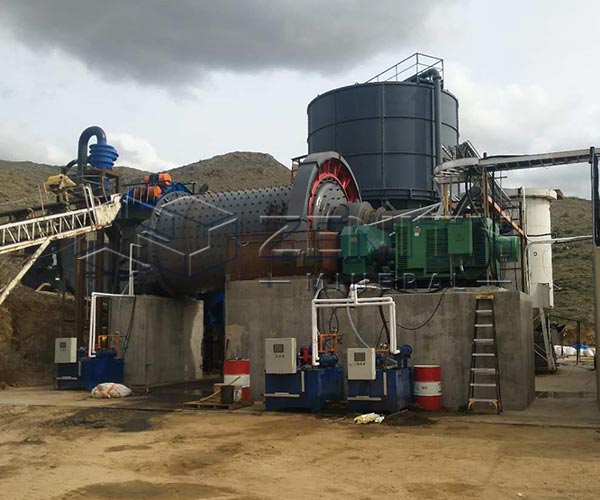
Ball mill manufacturers for Ethiopia’s mineral processing industry can supply efficient grinding equipment, EPC solutions, and after‑sales services that match local ore characteristics and project sizes. Selecting the right partner depends on factors such as mill design, energy efficiency, liner systems, and the manufacturer’s experience with African and especially Ethiopian projects.
Ball mills are key grinding machines that reduce crushed ore to fine particles, enabling effective liberation and downstream beneficiation in gold, iron ore, industrial minerals, and cement plants.
In Ethiopia, ball mills are commonly used after primary and secondary crushing stages for iron ore, gold, and other metallic ores, often operating in closed circuits with classifiers to achieve a controlled product size.
Typical configurations include cylindrical or slightly conical mills with steel ball media, designed to operate in wet or dry modes depending on the flow sheet, water availability, and target mineral.
Because grinding can account for a high share of total plant energy consumption, energy‑efficient ball mill selection and correct sizing are crucial for competitive operating costs in Ethiopia’s growing mining sector.
International manufacturers from China supply advanced ball mills with customizable capacities from 0.5 TPH to over 100 TPH.
Reputable suppliers offer turnkey mineral processing equipment, making it easier for Ethiopian companies to integrate crushers, classifiers, and conveyors with ball mills.
After-sales services—installation, commissioning, and training—are essential for mining operations in rural areas requiring reliable technical assistance.
Imported ball mills typically provide higher efficiency, longer lifespan, and better material quality, suitable for midto large-scale mineral processing plants.
Local fabrication options offer lower upfront costs and easier access to spare parts but may lack advanced automation and energy-saving features.
Decision factors include ore type, production goals, power availability, budget, and the long-term strategy of the mining operation.
Grid-type ball mills are ideal for coarse grinding of harder ores, common in Ethiopia’s gold and base-metal deposits.
Overflow-type ball mills provide finer output, useful for flotation processing of industrial minerals like feldspar and quartz.
Vertical roller mills appear increasingly attractive for cement raw materials and limestone grinding in Ethiopia’s growing construction sector.
Continuous or batch models can be selected based on plant size and operational preferences.
Large international manufacturers supply robust ball mills for African iron ore, gold, and base‑metal projects, offering complete grinding circuits with mill drives, liners, and classification equipment.
These suppliers typically provide design support based on ore hardness testing, allowing Ethiopian operators to optimize mill diameter, length, and media loading for higher throughput and better liberation.
Many global brands emphasize adaptability to multiple ore types, making it easier for Ethiopian mines to transition between different deposits or blend feeds without major hardware changes.
Some suppliers have experience with remote sites and limited infrastructure, which is important for Ethiopian projects that may face logistical challenges and require modular, easy‑to‑install grinding solutions.
Chinese and other Asian manufacturers offer competitive pricing on ball mills and associated mineral processing equipment, making them attractive for small to medium‑scale Ethiopian operations.
These suppliers often provide standard series mills with customizable options such as liners, drive types, and discharge arrangements, giving Ethiopian buyers flexibility within a controlled cost framework.
Some Asian manufacturers now market vertical and stirred ball mills that can provide high grinding efficiency and smaller footprints, which can help Ethiopian plants reduce energy use and building costs.
For Ethiopian buyers, an important consideration is ensuring that these overseas suppliers can offer reliable after‑sales support, spare parts logistics, and clear technical documentation in English or other accessible languages.
Engineering companies focused on mineral processing frequently integrate ball mills as part of turnkey plants for iron ore and gold, handling process design, equipment selection, and commissioning as a unified package.
In Ethiopia, this approach is advantageous for investors without deep process expertise, because it ties mill sizing and selection directly to the overall flowsheet, from crushing through concentration and tailings management.
These firms can supply auxiliary systems such as classifiers, cyclones, pumps, conveyors, and magnetic separators alongside the ball mill, creating well‑balanced grinding circuits for local ore types.
Some plant integrators have proven Ethiopian references in alluvial gold and hard‑rock projects, which can reduce technical risk and simplify permitting and financing discussions.
Ethiopian mines should evaluate mill capacity, power draw, and size to match ore throughput targets and expected mine life, avoiding undersized mills that limit future expansion.
Ore hardness, abrasiveness, and moisture content must be considered when choosing liner materials, mill speed, and media size distribution to maintain stable performance and acceptable wear rates.
Reliability and maintainability are vital, so buyers should examine the supplier’s track record, availability of critical spares, and compatibility with modern mill relining tools that improve safety and reduce downtime.
Integration with Ethiopian grid conditions and possible use of variable‑speed drives or soft starters can help manage power quality issues and optimize energy efficiency.
Successful ball mill deployment in Ethiopia depends not only on equipment quality but also on commissioning support, operator training, and continuous process optimization.
Manufacturers and integrators that offer on‑site training, remote monitoring, and regular performance audits enable Ethiopian plants to fine‑tune mill loading, speed, and classification for improved recovery.
Access to local or regional service centers and technicians reduces downtime caused by liner changes, gear issues, or drive failures, making lifecycle cost more predictable for mine owners.
In the long term, partnering with suppliers who understand Ethiopian regulatory, environmental, and infrastructure conditions can support smoother expansions and technology upgrades in the country’s mineral processing industry.
We have jaw crushers, impact crushers, cone crushers, sand makers and so on.
Mon - Sun, 0:00 - 24:00
24h Online Service
© Zenith. All Rights Reserved. Designed by


 WhatsAPP 24h online service


 24h Online Chat


