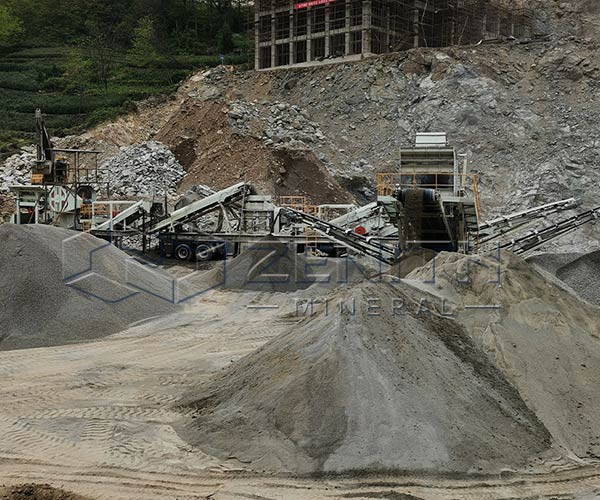
Aggregate production plays a crucial role in Ethiopia’s rapidly growing construction and infrastructure sectors. Crushers are essential machines that break large rocks into smaller aggregates used in roads, concrete, railways, and building projects. Choosing the right crusher ensures higher efficiency, lower operational costs, and consistent product quality. Below are some of the best crusher types commonly used for aggregate production in Ethiopia.
Crushers are machines designed to reduce large rocks, minerals, and construction materials into smaller aggregates suitable for construction applications. These machines apply mechanical force such as compression, impact, or attrition to break rocks into usable sizes.
Aggregate production typically involves several stages of crushing. The primary stage breaks large stones into medium sizes, while secondary and tertiary stages refine them into smaller, uniform aggregates suitable for construction materials.
Because Ethiopia has abundant natural stone resources such as basalt, granite, and limestone, choosing durable and reliable crushers is essential for efficient quarry operations.
Jaw crushers are among the most widely used machines for primary crushing in aggregate production plants. They operate using compressive force generated between a fixed jaw plate and a moving jaw plate to break rocks into smaller pieces.
These crushers are ideal for handling large, hard materials such as granite, basalt, and quartzite, which are common in Ethiopian quarries. The simple structure and robust design make them highly reliable in harsh mining environments.
However, jaw crushers usually produce coarse aggregates. Therefore, additional crushers are often required in later stages to refine the material into smaller sizes.
Cone crushers are commonly used in the secondary and tertiary stages of aggregate production. They crush materials by compressing rocks between a rotating cone (mantle) and a stationary outer surface (concave).
These machines are particularly suitable for producing uniform aggregate sizes required for concrete and asphalt production. Their ability to deliver consistent particle shapes makes them highly valuable in modern construction projects.
In Ethiopia, cone crushers are often combined with jaw crushers in multi-stage crushing plants to improve productivity and aggregate quality.
Impact crushers use high-speed rotating rotors equipped with hammers or blow bars to break rocks through impact force rather than compression.
These crushers are highly effective in producing finely shaped aggregates, which are essential for high-quality concrete and asphalt mixtures.
Impact crushers are especially useful when working with softer materials like limestone and sandstone. Many Ethiopian aggregate plants use them to produce fine aggregates for construction.
Vertical Shaft Impact (VSI) crushers are specialized machines used mainly in the final stage of aggregate production. They operate by accelerating rocks at high speed and causing them to collide with each other or with a hard surface.
This process produces very fine, cubical aggregates that are ideal for manufactured sand and high-quality concrete production.
As demand for manufactured sand increases in Ethiopia due to limited natural sand resources, VSI crushers are becoming increasingly important in aggregate plants.
Choosing the best crusher for aggregate production depends on several factors related to the quarry and production requirements.
Combining multiple crushers in a well-designed crushing plant ensures efficient production, improved aggregate quality, and long-term operational reliability.
We have jaw crushers, impact crushers, cone crushers, sand makers and so on.
Mon - Sun, 0:00 - 24:00
24h Online Service
© Zenith. All Rights Reserved. Designed by


 WhatsAPP 24h online service


 24h Online Chat


