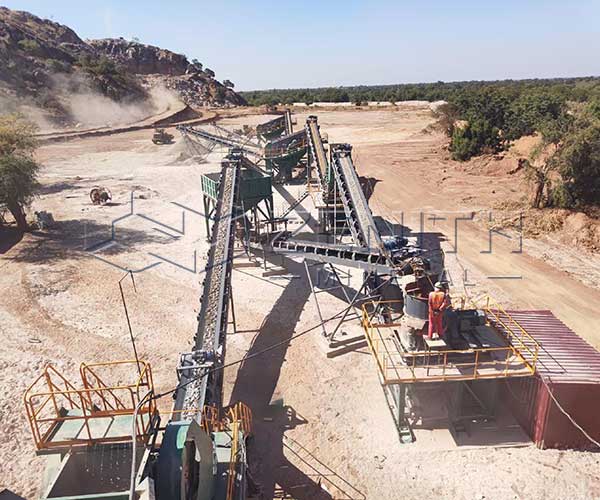
Ethiopia possesses abundant limestone deposits distributed across regions such as Mugher, Mekelle, Dire Dawa, and the central highlands. These resources form the backbone of the country’s cement, construction aggregate, and lime production industries.
Limestone demand is driven mainly by infrastructure expansion, housing projects, and industrialization.
The quality of Ethiopian limestone ranges from medium- to high-calcium content, suitable for cement and metallurgical applications.
Proximity of quarries to cement plants reduces transportation costs and influences equipment selection.
As the construction sector grows, efficient limestone crushing systems become critical for consistent supply and cost control.
Each stage must be carefully coordinated to ensure stable output, minimal downtime, and uniform particle size.
Primary crushing is the first and most critical step in limestone size reduction. Equipment selection depends on feed size, hardness, and capacity requirements.
Commonly used in Ethiopian limestone plants.
Suitable for large feed sizes and hard rock.
Simple structure and easy maintenance.
Applied in high-capacity cement plants.
Offer continuous crushing and high throughput.
Regulate material flow into the crusher.
Protect equipment from sudden load surges.
These machines form the foundation of a reliable crushing line.
After primary crushing, limestone is further reduced to meet product specifications through secondary and tertiary stages.
Ideal for softer limestone varieties.
Produce well-shaped aggregates.
Widely used in aggregate and cement applications.
Preferred for harder limestone and higher capacity.
Deliver consistent output and lower wear rates.
Used when fine particles and cubic shapes are required.
Common in high-quality aggregate production.
Multiple crushing stages improve efficiency and product quality.
Supporting systems are essential for smooth operation and material handling in limestone crushing plants.
Separate crushed limestone by size.
Enable closed-circuit crushing for better control.
Transport material between crushers and stockpiles.
Designed for long distances and high loads.
Reduce airborne particles.
Improve working conditions and environmental compliance.
These auxiliary systems ensure continuous operation and reduce material losses.
The 100-120 TPH mobile line in Addis Ababa, supports national housing goals by supplying aggregates for 3,000+ units annually. It integrates jaw and impact crushers for on-site efficiency, cutting transport costs by 30%.
Another success is the 300 T/H stationary line, equipped with PE1200×1500 jaw, PF1620 impact, and HST cone crushers, processing up to 1,000 mm feed into 0-30 mm output. Located in central quarries, it exemplifies high-capacity operations for cement giants.
Addis Ababa Mobile Plant: Quick setup (under 24 hours); serves urban construction boom.
300 T/H Fixed Line: Recycle system yields 95% efficiency; annual output exceeds 500,000 tons.
Expansion Trends: Foreign investments from China driving hybrid mobile-fixed hybrids.
Selecting the right limestone crushing equipment requires balancing technical, economic, and local factors.
Hardness, moisture, and abrasiveness of limestone.
Matching crusher size to plant output targets.
Availability of spare parts and technical support.
Reducing operating costs and power consumption.
A well-designed crushing system enhances efficiency, reliability, and profitability for Ethiopian limestone projects.
We have jaw crushers, impact crushers, cone crushers, sand makers and so on.
Mon - Sun, 0:00 - 24:00
24h Online Service
© Zenith. All Rights Reserved. Designed by


 WhatsAPP 24h online service


 24h Online Chat


